
The Colonizer We Carry
On anti-blackness, survival tactics, and why shame is keeping Latinos from their own liberation.

I was the favorite cousin. The lightest one. The one with the “good hair” — soft, manageable, closer to white. Nobody said it out loud. They didn’t have to. The hierarchy was communicated in how I was held, praised, positioned. My cousins who were darker, more visibly Black, felt the difference too. We all did.
My mother is Black. She will deny it violently.
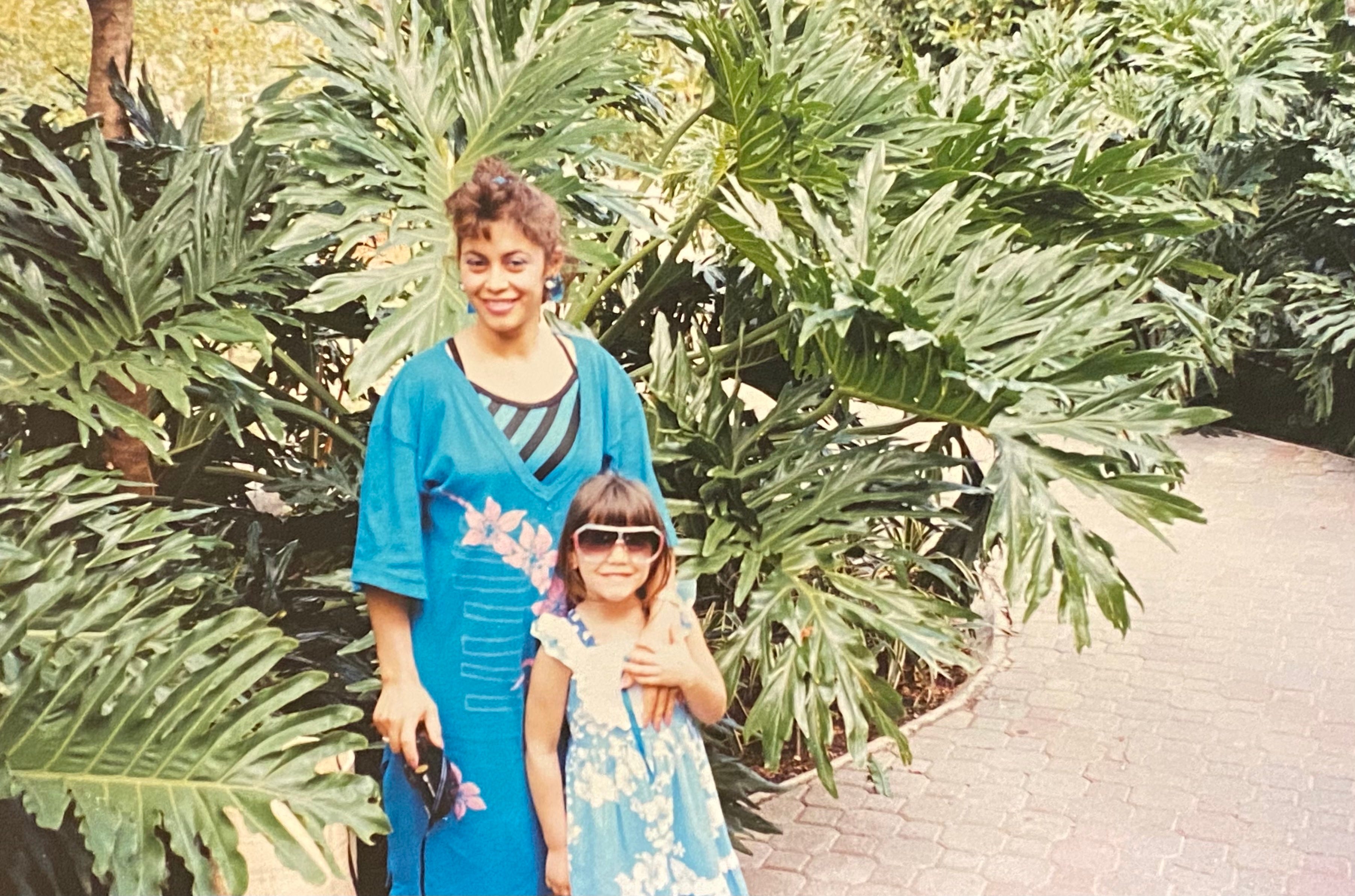
That sentence took me years to be able to write. Not because I didn’t know it was true, but because naming it meant naming what was done to her — and what she, in turn, passed on.
The self-erasure. The performance of proximity to whiteness. The inherited shame of Blackness that was never really hers to carry.
It was handed to her by a culture shaped by colonization, and before that, by a dictator who made anti-Haitian, anti-Black sentiment feel like national pride.
This is where the story starts. Not in a Texas voting booth. Not in an exit poll. Here. In the way a Dominican mother looks in the mirror and refuses to see herself.
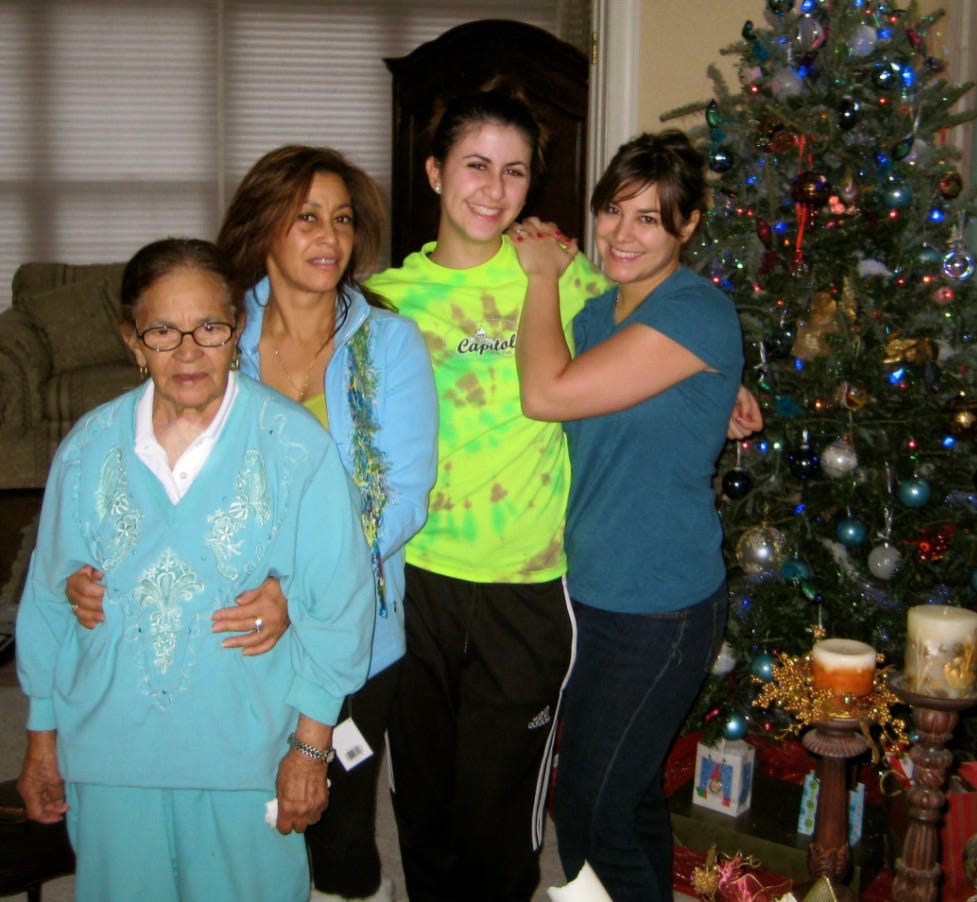
Three generations of everything I’ve been trying to unlearn. My abuela is on the left. The lineage is in the details — if you know, you know
Survival Became Strategy. Strategy Became Identity.
Anti-blackness in Latino communities is not a mystery. It is not random. It is the residue of colonization. centuries of being taught that proximity to whiteness meant safety, resources, survival. For many of our ancestors, it wasn’t aspirational. It was tactical. Distance yourself from Blackness, and maybe the violence lands somewhere else.
The problem is that survival tactics calcify. They get passed down not as “here is what we did to stay alive” but as “here is what is correct.” The tactic becomes the value.
The value becomes the identity.
And suddenly you have a grandmother who harbors real resentment toward Haitians who have never done a single thing to her — because Rafael Trujillo told her to, decades ago, and nobody ever gave her permission to put it down.
Research bears this out. A 2021 study published in Social Forces found that colorism within Latino communities tracks closely with colonial-era racial hierarchies, with lighter-skinned Latinos reporting significantly higher social capital and economic mobility than darker-skinned counterparts. The preference isn’t aesthetic. It’s structural. It has material consequences. And it is reproduced inside our own families before we ever step foot in a school or a voting booth.
Walking Two Lanes
I know what it costs to live in the in-between. My father’s family is (very southern Appalachia) white. My mother carries Blackness she won’t claim. I have spent my entire life code-switching between those two worlds. Knowing how to move in white spaces, feeling most at home in Black ones, and never quite having language for why until two Black women at my job handed it to me.
I was sharing family photos. They were surprised. My closest relations — my mother — were visibly Black, and I had never claimed that. I was occupying Black spaces, gravitating toward them naturally, while simultaneously performing the distance my family had taught me. These two women didn’t shame me. They made space.
They helped me see that denying my own Black roots wasn’t neutral — it was an act of harm against myself. It was depriving me of wholeness.
That moment cracked something open. Because once you see it in yourself, you cannot unsee it anywhere. You start recognizing the same performance in your community, in the political choices, in the way some Latinos in this country have decided that whiteness (even just the approval of whiteness) is worth voting against their own survival.
«insert painful eyeroll»
Texas Was Not a Surprise
In the 2024 general election, Latino voters in South Texas shifted toward Republicans at rates that rattled Democratic strategists. Counties along the Rio Grande that had voted Democratic for generations flipped or came dangerously close. But the more revealing story came just this week in the Texas Democratic Senate primary.
Jasmine Crockett (the Black congresswoman who showed up in ICE detention centers, who fought publicly and loudly for immigrant families, who was doing the actual work) lost to James Talarico, a seminarian and state lawmaker who ran on faith, moderation, and a “politics of love.” Polling showed Talarico leading among Latino voters 60% to 39%. He courted them aggressively — Tejano music stars, Spanish-language ads, Latino influencers. And it worked.
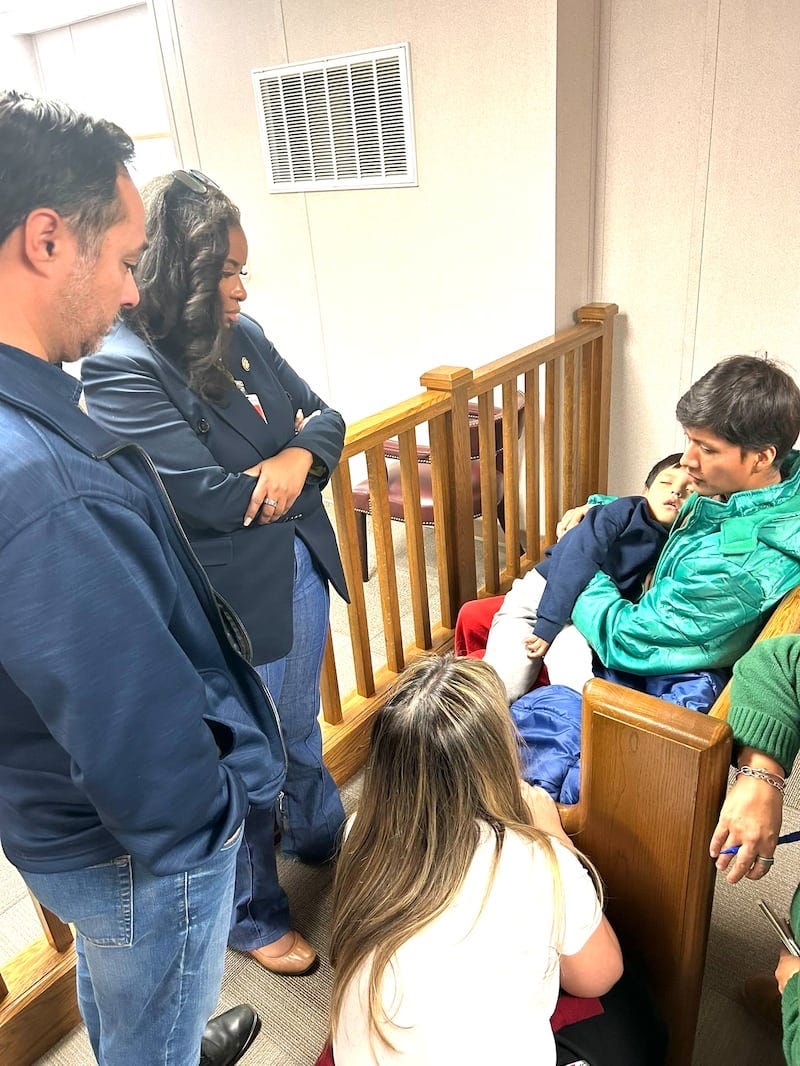
This was not a Republican vote. It was a Democratic primary. But it was still a rejection, of the Black woman who had their back, in favor of the candidate who felt more culturally and spiritually familiar. That distinction matters and it doesn’t. Because the outcome is the same:
the person fighting hardest for that community lost, and the community’s own vote helped make it happen.
The explanations offered range from cultural conservatism to failed outreach to racial polarization. All of those things are partially true. None of them are the whole story.
The whole story is that a significant portion of Latino voters have so thoroughly internalized the logic of proximity (to whiteness, to faith-coded respectability, to moderate comfort) that they cannot recognize their own liberation when it’s on the ballot. That is not a messaging problem. That is not a ground game failure. That is a community still making survival calculations in conditions that no longer require them.
Zohran Mamdani’s 2025 New York City mayoral campaign offers a useful contrast. Mamdani demonstrated what genuine cross-cultural political fluency looks like — meeting Latino communities not just linguistically but emotionally, engaging with economic anxiety without exploiting it, building coalitions rooted in shared interest rather than manufactured fear. The difference between Mamdani and Talarico is not style. It is whose interests are actually centered.
But here is where I have to be honest:
I have lost patience with the idea that outreach alone fixes this. Some of our people are not waiting to be reached. They are waiting for permission to assimilate.
No amount of cultural fluency from a candidate undoes decades of internalized anti-blackness. That work has to happen inside the community. Inside the family. Inside yourself.
My Mother Thinks She Is White
She walks around like ICE won’t snatch her up. Like the protections she imagines proximity to whiteness affords her are real. She carries Trujillo’s propaganda about Haitians as if it is her own organic belief — resentment toward people who have never harmed her, inherited from a dictatorship that used anti-Blackness as a tool of national control and was overthrown when she was a child.
I do not pity her anymore. That took time. There was a long period where I tried to reach her, to introduce the language of decolonization, to help her see what she was doing to herself. I have made peace with the fact that some people are not ready. Maybe will never be ready.
What I cannot make peace with is the children. The ones who did not vote for any of this. The ones being torn from families by a system that does not distinguish between the Latino who voted for it and the one who didn’t.

The MAGA Latino and the undocumented child share the same consequences. That is the part that keeps me up at night — the innocents absorbing the full cost of choices they had no part in making.
There is no clean separation between those two things. You cannot celebrate the crackdown and then be surprised when it lands on your doorstep.
Shame Is Not the Destination
Here is what I want Latinos reading this to understand:
the shame you are going to feel when the truth finally lands is not the end of the road. It is the beginning.
Yes, there will be shame. There should be. Looking at the ways anti-blackness has lived in your family, in your own behavior, in your vote — that is not comfortable. It is not supposed to be. But shame is only useful if you move through it. Staying in it, or worse, defending against it by doubling down, is what keeps us exactly where we are.
Your ancestors did not survive the Middle Passage, colonization, dictatorship, and migration so that you could vote to deport your neighbors. They did not fight, grieve, endure, and build so that their grandchildren could perform whiteness in exchange for the illusion of safety.
The liberation that is available to us (economically, politically, culturally) exists on the other side of that reckoning. It requires putting down the colonizer’s framework for what is valuable, what is beautiful, what is worth protecting. It requires claiming the fullness of who we are, including the Blackness so many of us have been taught to hide.
We are out of time for slow unlearning. The consequences are too immediate and too real.
Wake up. Grieve what was taken from you. Put down the shame. And then get to work — on your terms, not theirs.
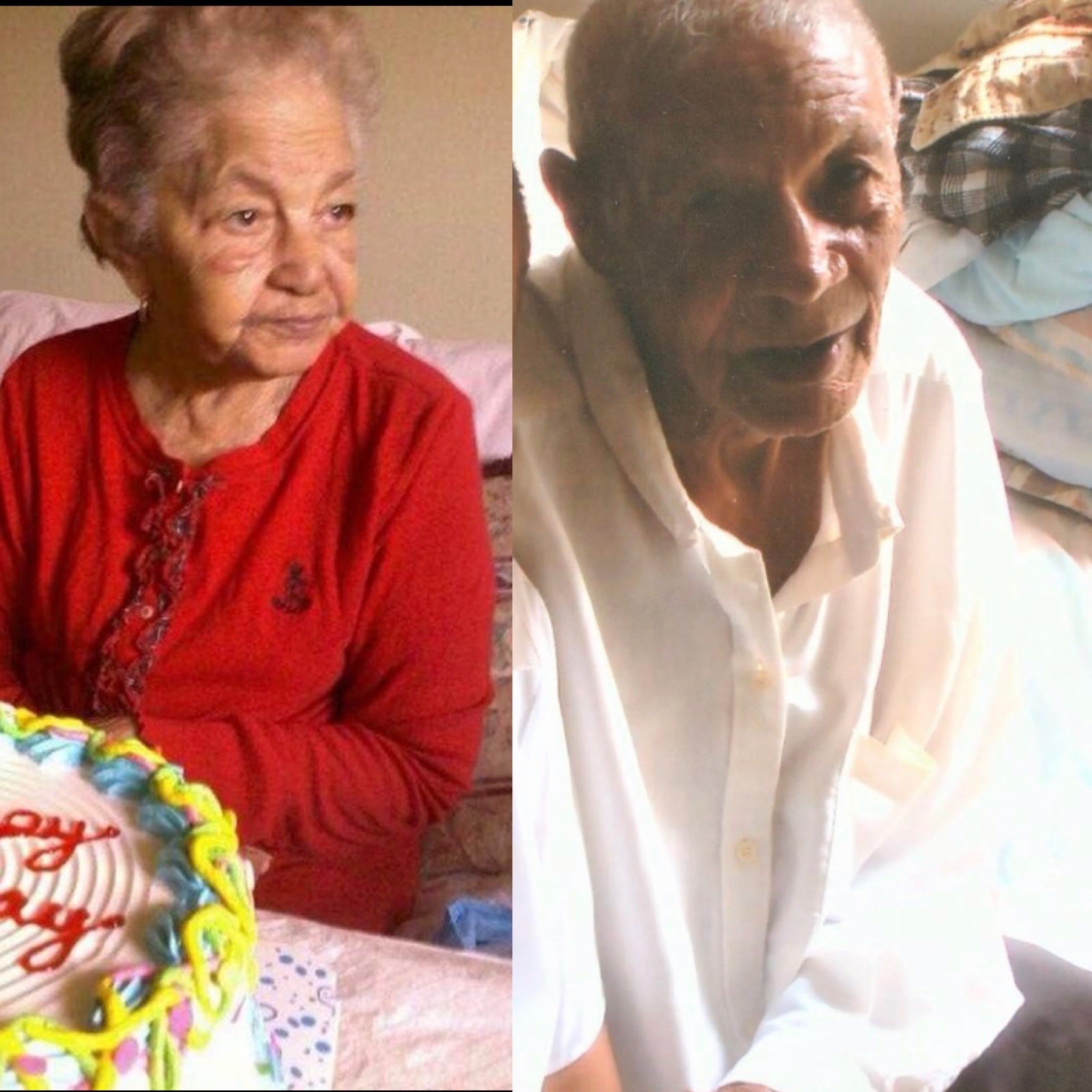
Mis abuelos. Gracias por sobrevivir. Gracias por aguantar. Lo que me dejaron, el dolor y la fuerza, lo estoy sanando con amor.
Sources referenced: Social Forces (2021) study on colorism and social capital in Latino communities; 2024 general election county-level voting data, Rio Grande Valley; Emerson College Polling, Texas Democratic Senate Primary, February 2026; Texas Tribune and 19th News coverage of the Crockett/Talarico primary, March 2026; Zohran Mamdani 2025 NYC mayoral campaign coverage